

The Academy of
Religious Leadership

Deepen | Develop | Disseminate

The Academy

The Academy of Religious Leadership (ARL) exists to enhance religious leadership education; convene a scholarly roundtable of leadership educators and professional practitioners for the purpose of faculty development and community; and foster and disseminate leadership education and research.

The Meeting

The ARL Annual Meeting invites scholars and practitioners into thoughtful conversation about the (r)evolutionary vocation of leadership. Our methods: discussing provocative, original papers/presentations, networking, and imagining an emerging future in the theological education, formation, and ongoing development of religious leaders in a fast-paced, challenging world.

The theme of our 2026 annual meeting will be “Public Leadership and Prophetic Witness”. It will be held in St. Paul, MN April 23-25, 2026.

The Journal

The Journal of Religious Leadership is published semi-annually by the Academy of Religious Leadership (ARL). As a peer-reviewed journal, the editorial team assesses articles by four criteria: scholarship (in an effort to promote faithful critical thinking about religious leadership), theological (as ARL is focused on religious leadership, matters of faith and practice are instrumental), expansive (the work of ARL seeks to extend and deepen both religion and leadership), and suggestive (work suggests outcomes, practices, behaviors, implications, etc. for readers to incorporate in their contexts).
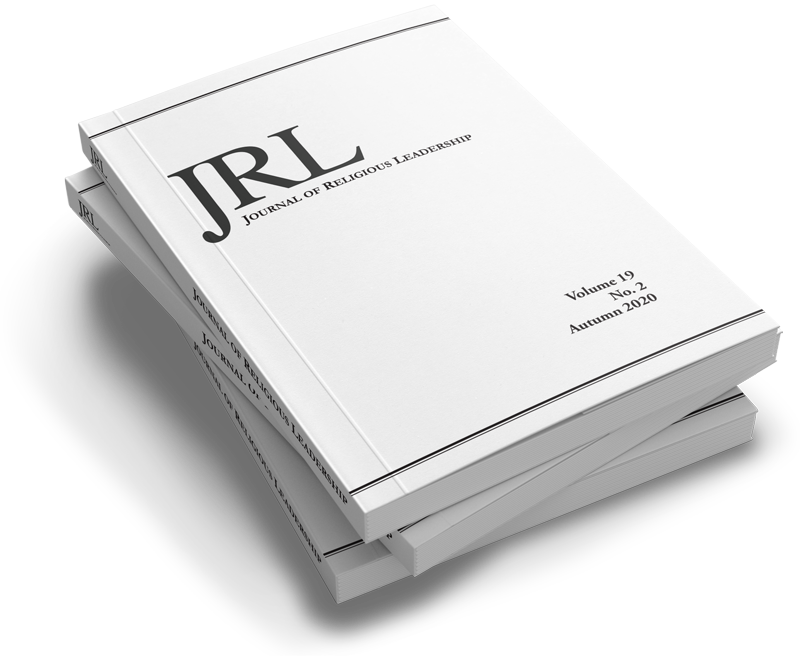
Featured in the latest issue of the Journal for Religious Leadership

Articles

What does justice look, sound, smell, taste, and feel like for religious leaders and communities?

ARL Co-President Kristina I. Lizardy-Hajbi set the terms of these responses by wondering about the nature and tenor of “Just Leadership”, the theme for the 2025 ARL conference. She pulled theory toward praxis to make visible the material realities often experienced in the practice of such leadership. She considers how our senses themselves might shape religious leadership as justice. The contributors to the Fall 2025 JRL have incorporated the senses, in one form or another, into what they offer in this issue.

Susan Maros and Phil Allen, in their contribution “Impact of Leaders’ Racial-Ethnic- Cultural Identity Development on Capacity for Just Action,” put forth a model that asks leaders to sense into/intuit their own racial-ethnic-cultural identity development and the development of those with whom they work. Maros and Allen contend that such reflection is necessary for leaders who seek to enact justice.

Rebecca David Hensley spoke with and listened to community organizers in Texas to develop a just religious leadership that critically examines Whiteness in the article “Un-Suturing Reflexive Whiteness: Recognizing and Resisting White+Christian Dominance in Racial Justice Movements.” Hensley suggests several praxes and traits that White Christian leaders should embrace in the process of “un-suturing” from the White moral imaginary.

Eunjin Jeon and Byung Ho Choi, in “Reimagining Pastoral Leadership: Practical Wisdom from Ordained Women Pastors in South Korea,” listened deeply through an embodied practice of “friendship-talk” to the experiences of female pastors in the Presbyterian Church of Korea (PCK) to learn how they lead within patriarchal church structures. Jeon and Choi found that models centering koinonia-centered practice, motherhood as theological leadership, and radical interdependence challenge dominating paradigms and move the church toward just leadership.

In “From Performance to Formation: Reimagining Servant Leadership Education,” Kyle J.A. Small and David G. Forney articulate a reframing of Servant Leadership from a surface-level, leader-centric engagement to a relational and communal praxis that is developmental in scope. Through five pedagogical “movements,” Small and Forney reorient Servant Leadership praxis as a curriculum of liberation. In distinct ways, each of the authors in this issue has asked the question: What does justice look, sound, smell, taste, and feel like for religious leaders within particular communities? Their nuanced, carefully articulated, and sensory-informed responses to this query hold wisdom for us all.